





In early November 2025, Penelope received a phone call while driving home from work in New Jersey, United
It was her doctor delivering the news she had been waiting to hear for years.
After two and a half years of emotionally exhausting attempts, she was finally pregnant.
Following numerous medical tests, Penelope and her husband Samuel discovered that he had Klinefelter syndrome, a genetic condition affecting men born with an extra X chromosome — a disorder that often goes undiagnosed until adulthood.
Most men with Klinefelter syndrome produce very few or no sperm cells at all, a condition known as azoospermia, which affects roughly 10% of infertile men.
Overwhelmed with joy and disbelief, Penelope waited until Samuel returned home that evening to share the news. (Both names have been changed for privacy reasons.)
“His face was a whirlwind of emotions,” she recalls.
“He cried because we had finally reached this point after so much effort, time, and research. And the fact that we only had one embryo and it worked — we were incredibly happy,” she says.
Their pregnancy became possible thanks to a groundbreaking new technique known as the STAR System (Sperm Track and Recovery), developed at Columbia University to identify sperm cells in men diagnosed with azoospermia.
The system uses artificial intelligence to detect and isolate the rare “hidden sperm” that may still exist in men with this condition.
“I was terrified. I thought I would never be able to have my own child, which is something deeply important to me,” Samuel explains. Doctors had told him he had only a 20% chance of fathering a biological child.
“And that was devastating,” he says.
The Fight Against Infertility
Infertility affects millions of people worldwide, with approximately one in six individuals of reproductive age experiencing difficulties conceiving at least once in their lifetime.
Male infertility contributes to nearly half of all infertility cases, while about 1% of men are azoospermic.
This means millions of men globally may have sperm counts so low — and sperm cells so difficult to detect — that they are considered infertile.
Now, AI-powered technology capable of finding these hidden sperm cells could offer new hope to families longing to become parents.
By late 2025, after five years of development, the first baby conceived using the STAR System was born, allowing a couple who had struggled with infertility for nearly two decades to finally have a child.
“It was an incredible moment,” says Zev Williams, director of Columbia University’s Fertility Center.
“Everyone was jumping with excitement,” he recalls.
“There are very few things in life where years of hard work result in something as extraordinary and meaningful as this. Now there’s a baby girl — and hopefully many more to come.”
Since the birth of the first STAR baby, the technology has been used regularly at the fertility center, while the waiting list for prospective patients has grown into the hundreds worldwide.
According to Williams, among the latest 175 patients who underwent the procedure, sperm cells were successfully found in nearly 30% of cases.
These were patients who had previously been told they had virtually no chance of having biological children using their own sperm.
Additional testing showed that STAR identified up to 40 times more sperm cells than manual searches performed by highly trained laboratory technicians.
Detecting a Single Sperm Cell
Under normal conditions, a semen sample contains tens of millions of sperm cells per milliliter.
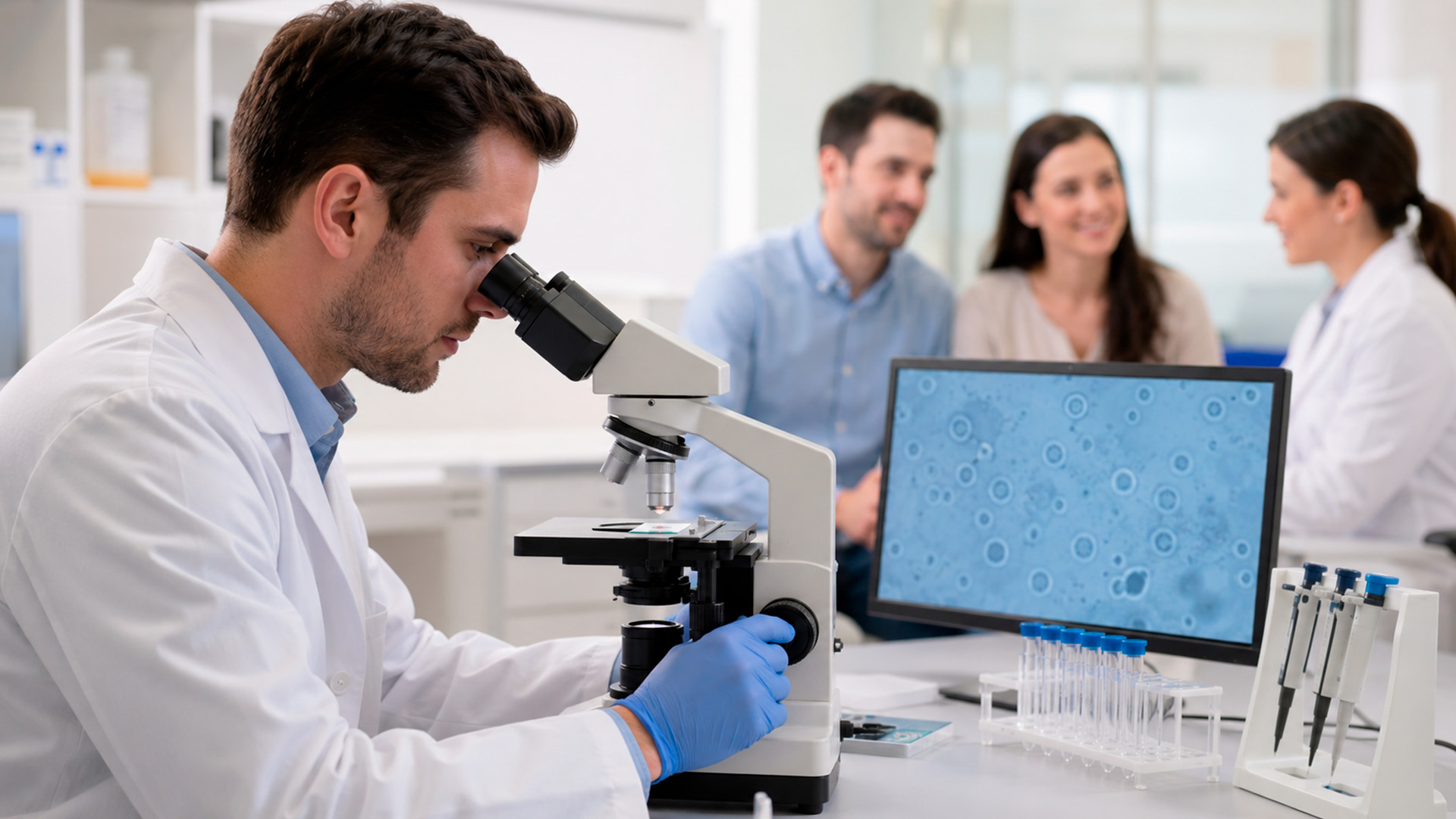
Typically, a small droplet is examined under a microscope to evaluate sperm count, movement, and overall health.
However, in azoospermic patients, there may be only a single sperm cell in the entire sample — or none at all.
Searching through microscopic droplets manually becomes nearly impossible.
Williams first conceived the idea for STAR in 2020 after reading about how artificial intelligence is used to discover new stars in astronomy.
Modern telescopes generate enormous amounts of data from the night sky — far too much for astronomers to manually analyze in search of previously unseen celestial objects.
Machine learning algorithms, however, can process this information in minutes.
“The image of the sky looked remarkably similar to what we see in samples from men who are told they have no sperm,” Williams explains.
That realization led him to wonder whether similar technologies could be used to identify and isolate sperm cells.
Williams and his team were already using high-powered imaging systems capable of scanning semen samples. The real challenge was processing hundreds of images per second in real time while detecting and extracting sperm cells.
The STAR system combines advanced imaging with microfluidic chips — microscopic glass or polymer channels as thin as a human hair — through which semen samples flow while being scanned.
A machine-learning algorithm analyzes the images in real time, identifying sperm cells so they can be isolated as gently as possible without causing damage.
“As the sample flows through the system, we capture 300 images per second,” Williams explains.
“Most of what we see is debris and cellular fragments. It’s not a clean liquid. We’re trying to find one extremely rare sperm cell hidden within all that noise.”
According to Williams, the STAR method has achieved a sensitivity of 100%, meaning it can detect a sperm cell even if only one is present in the sample.
“We’re finding something that was previously invisible,” he says.
Isolating Eight Sperm Cells
Once detected, a robotic system extracts the sperm cell within milliseconds.
“The microfluidic robotic system removes the tiny droplet containing the sperm cell,” Williams explains.
“You end up with one tube containing the seminal fluid without sperm, and another microscopic droplet containing the sperm itself.”
In Samuel’s case, there was an additional complication — and a first for the STAR system.
Men with Klinefelter syndrome do not release sperm through ejaculation, meaning doctors must retrieve sperm directly from the testicular tissue.
Samuel underwent hormone therapy for nine months before completing a surgical sperm extraction procedure at another fertility clinic.
The tissue sample was then sent to Columbia University for analysis.
“The surgical tissue was transported to our andrology laboratory and processed before running it through the STAR system,” says Eric Forman, Medical and Laboratory Director at Columbia University Fertility Center.
At the same time, Penelope was undergoing egg retrieval treatment.
Typically, a fresh sperm sample is used the same day for the best chance of fertilization — meaning the team was racing against time.
The STAR system successfully isolated eight sperm cells from Samuel’s sample, which were then injected into Penelope’s eggs.
One developed into a healthy blastocyst — an advanced-stage embryo.
Their baby is expected to be born at the end of July.
“Now it finally feels real, especially because I can feel the baby moving,” Penelope says.
“We had our anatomy scan, and everything looks great.”
Caution Around Overpromising
Finding rare sperm cells is not the only way artificial intelligence is reshaping fertility medicine.
Machine learning is also being used in ovarian stimulation treatments to personalize hormone dosages, while deep-learning systems help identify the healthiest embryos and reproductive cells during IVF procedures.
However, experts caution that larger clinical trials and long-term studies are still needed to fully evaluate the effectiveness and safety of these technologies.
Concerns also remain regarding sensitive medical data, privacy protections, and questions surrounding legal responsibility and ownership.
There is also growing concern that vulnerable couples facing long infertility journeys may be exposed to expensive treatments with unproven outcomes.
“Couples who have struggled with infertility for years can become desperate to conceive and may be vulnerable to being sold costly treatments with limited evidence,” explains Siobhan Quenby, Professor of Obstetrics at the University of Warwick.
“It’s incredibly exciting to see advanced imaging, engineering, and AI come together to create new solutions for severe male infertility,” she adds.
“But one successful pregnancy is only the beginning. Much more research involving larger groups of patients is still needed before the true value of this treatment can be fully understood.”
For Samuel, however, the possibility that AI-driven fertility technology could one day help expand his family again is deeply encouraging.
“Of course we want another child someday,” he says.
“But for now, we finally have hope where there once was none.”
.
FUENTE: BBC.COM